I walked in my local Ace Hardware to buy a padlock for my son’s locker at school and I told the cashiers what I was looking for. They told me it was on the left about half-way down the center isle. So I start walking down the isle and I’m met by another store employee. The nice thing about Ace is they have great service. But what surprised me is that the employee looked at me and said, “Looking for a padlock?” I asked her if I had that written on my face or is she just psychic?
It turns out they were using the new Motorola CLP101o two-way radios. The radios are so small and light that you couldn’t even see where they put them. Most of the employees just had them stuffed in a pocket, but I finally caught a glimpse of one employee who had hers on the outside of her clothing. I then recognized them immediately since there’s no other radio like it and the glowing indicator ring is a dead giveaway.
So a store with great service just got even better by adding better communication!
Wireless PA systems are often used at truck scales for one-way communication to a truck driver. An operator in the scale house can simply press a button and broadcast a message to the driver. These systems can broadcast at high volume levels so they can overcome the noise level of a loud diesel engine.
The PA system consists of a wireless receiver unit that’s attached to a horn speaker. In the scale house the operator an use a portable handheld radio or a desktop base station radio to broadcast messages to the trucks.
With concern about crime, vandalism, and terrorism continuing to increase, the need for security increases, and the place most businesses and residences start is with installing a perimeter security system such as fence with a gate. When a gate is installed, a wireless intercom becomes an essential part of the system so visitors can still get in.
A wireless intercom at the gate will need to be water resistant, but it should also be vandal resistant as well. It will be exposed to the elements and to people who may want to damage it. Therefore the chosen intercom must be very durable.
If wires cannot be installed in the ground, then a wireless intercom is needed. The range these devices can transmit varies widely, but you can get intercoms that transmit as much as a mile or more.
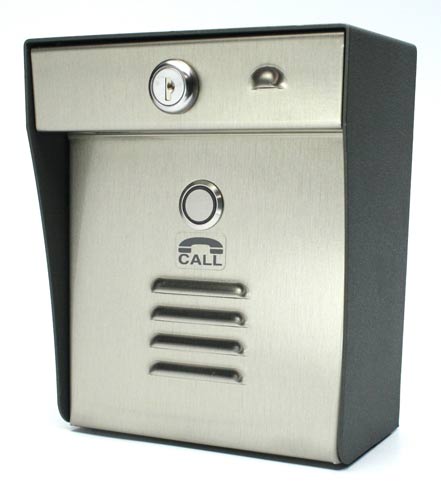
The other factor is the appearance of the intercom. In some installations a wireless intercom with an industrial appearance is OK. In others, you may need one that is a little less unobtrusive like the one pictured here.
Whichever type of wireless intercom you choose, make sure you get one that can remotely activate the gate if you need that feature.
IntercomsOnline.com issued a press release about how a wireless callbox and the new Motorola CLP1010 and CLP1040 two-way radios can enable security guards to monitor security gates and doors without being confined to a desk. The new CLP radios are the smallest and lightest business radios available so security guards can comfortably carry them all day long.
We are please to announce that IntercomsOnline.com is now a Motorola Authorized Business Two-Way Radio Reseller. We currently offer Motorola’s most popular business two-way radios, the new ultra-small CLP series, the small CLS series, and the DTR digital series. Click on the link above for more information.
Fast and effective communication is needed in restaurants to provide the best customer experience, but restaurant staff don’t want to wear bulky two-way radios. They need radios that are comfortable to wear, unobtrusive in appearance, and easy to use. The Motorola CLP1040 radios fit that need.
The CLP1040′s sleek design won’t detract from staff uniforms. In fact, the optional magnet-mount accessory enables staff to locate the radio anywhere on their uniform.
While the CLP is the smallest and lightest business-class two way radio on the market, it’s still durable and has ample volume to overcome noisy kitchen environments. Wait staff won’t have to yell in their microphones and kitchen staff will still be able to hear them. Restaurant guests will experience exceptional service without even be aware of all the intricacies behind that service.
The four channel Motorola CLP1040 and the one channel CLP1010 are the best restaurant two-way radios available.
The Motorola CLP1040 and CLP1010 are the smallest and lightest two-way radios for the hotel and hospitality industry. These radios enable hotel staff with rapid communication to ensure guests have smooth arrivals and departures, excellent service during their stay, and fast access to transportation.
Unlike other bulky radios, hotel staff won’t mind wearing one of these radios. They weigh less than 2.5 ounces and measure at approximately 3.5 x 2 x 0.75 inches small. They come with a belt clip, but there is also a magnet mount option that enables staff to clip a radio anywhere on their clothing. A magnet goes inside the clothing and the radio attaches over top it.
The sleek styling promotes the hotel’s image, while the military specification standard ensures the radio is durable enough for tough, everyday use.
If you’re looking for a two way radio for your employees to use in a retail store, one of the best options available is the Motorola CLP1040. This ultra compact radio is the smallest and lightest radio available. The CLP1040 doesn’t have a built-in speaker so it requires users to wear a headset, which is included with the radio. Other headset options are available too.
One of the nicest features of the radio besides its small size, is the magnetic mount option. It allows you to clip the radio anywhere on your clothing you want. There is a belt clip that comes with the radio, but for those who don’t want to wear it on their belt, or they don’t even have a belt, the magnetic clip works very well.
There are four channels on the Motorola CLP 1040 and voice prompts and color-changing LEDs tell you which channel you are on. There’s a good review of this radio here: Motorola CLP1040
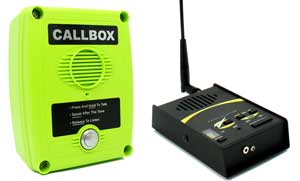
A new long-range wireless outdoor intercom enables you to communicate at distances that no other wireless intercom is capable of. Most wireless intercoms communicate at a range of up to 1000 feet. With the Multi-Mile Wireless system you can reach distances measured in miles depending on how it’s used. You can adjust range by changing between the intercom’s one-watt or two-watt setting. The one-watt setting works for shorter distances or when using battery power.
To achieve maximum range, there is an external antenna that you can mount as high as possible. The higher it’s mounted, the longer range you’ll get. The antenna comes with about three feet of cable, but you can add more to raise the antenna higher.
The long-range wireless intercom also has internal switch that can be used to activate a door or gate controller, switch on a light, sound an alarm, or for any application where remote control of an on/off switch is needed. A radio that has the ability to send the tones to activate the switch is needed.
The Motorola CLP1040 is the smallest business-class two-way radio on the market and it fits nicely in a wide variety of applications, even outside the hospitality and retail industries that it is designed for.
Size
The greatest advantage of the CLP1040 is its small size. It measures at just 3.5 x 2 x 0.75 inches with a weight of 2.38 ounces using the standard battery and 3 ounces with a high capacity battery. It will truly fit in the palm of your hand. One of the biggest complaints to 2-way radio usage is that users don’t like wearing a larger or heavier radio. With this radio, users will barely know it’s there.
Along with its tiny size Motorola also came up with another smart design element. All other two-way radios have a belt clip for carrying the radio. This may be fine if you’re wearing a belt. However, one of Motorola’s target markets was the retail industry. If you think about the type of clothing being worn by employees in a high-fashion woman’s clothing store, there aren’t a lot of belts. So Motorola came up with a magnet-mount option for the CLP series. The wearer simply places one side of the magnet mount inside the clothing, and then place the radio directly on top of that. Since the radio is sleek and light, it will stick almost anywhere. Of course they do have a belt-clip option available too.
Power Output
Since the CLP only has one watt of power, the range it will transmit will not be as far as 2-way radios with higher wattage. Plus it has a built-in antenna so that may not give the you the range of a longer two way radio antenna. But for most applications, one watt will be more than sufficient. The good part of this lower wattage is that battery life is longer.
If you don’t need to transmit very far there is a half-watt setting too. You probably want to use this setting if it works well for you because that limits how far your radios transmit. That means people farther away can’t hear your conversations and since these radios are not secure, that may be to your benefit.
UHF Frequencies
The CLP1040 uses business-band UHF frequencies between 450-470 MHz to transmit and receive. The benefit of UHF is that there are a greater number of channels available, and the CLP gives you a total of 90 available frequencies to choose from. UHF is good for use inside buildings, which is the primary target market for this radio.
Motorola claims a unit-to-unit range of up to 160,000 square feet and 12 floors of building coverage. Of course you can use a repeater to increase range, but that will add extra expense and complexity to your installation.
FCC License
The UHF frequencies these radios use do require an FCC license to operate on them. At least that’s the law. In reality most people don’t get a license since the FCC makes the process too complex. If you don’t get a license, just know that someone who does get a license could complain to the FCC that you are transmitting on their frequency and you will have to stop using it. But given that there are 90 available frequencies for the Motorola CLP1040, you could just find one that doesn’t seem to be used and use that instead. If you can use the half-watt setting on the radio, that will reduce chances of interfering with other radios as well.
Military Specification Standards
In an effort to achieve standardization objectives for purchases of products used by the military and other government organizations, the U.S. Department of Defense created standards that these products must meet. You will see these standards called military standard, “MIL-STD”, or “MIL-SPEC.” These standards ensure products meet certain requirements, commonality, reliability, compatibility, and similar defense-related objectives.
The Department of Defense also has standards for two-way radios and radios that meet this standard must meet levels for such criteria as vibration, rain, salt air, sand/dust, shock (dropping), humidity, temperature as well as other factors.
The CLP1040 has been tested MIL-STD-810, which indicates it should work in some pretty tough environments, like a restaurant kitchen for instance.
Headsets Required
One thing you need to keep in mind about the CLP 1040 is that there is no built in speaker so you will be required to use a Motorola headset. You can’t use headsets by other manufacturers since accessory jack is custom made for this radio. Fortunately Motorola has some good options, but you’ll have to pay Motorola prices for them. With that you also get a quality headset that will last a little longer than some cheap headset. The good thing about the headsets is that they screw into the CLP so they won’t pull out if the radio is bumped or dropped.
Battery Life
The Motorola CLP uses long-lasting lithium-ion batteries. The standard battery that comes with the CLP1040 has a 9 hour battery life, which should be sufficient for most business days. This life is calculated based on 5% transmit, 5% receive, and 90% standby. In situations where users communicate much more frequently than that, the high-capacity battery with a 14 hour life could be used. Changing batteries is easy so spare batteries could easily be swapped out as well.
Usability
The CLP1040 has been designed for ease of use so personnel will not need a lot of training to operate them. To transmit a user simply presses and holds the large, easy to find Push-to-Talk (PTT) button on the front of the radio, or some of the headsets have an inline PTT.
One of the challenges with a radio this small is finding a way to activate the features it has, especially when there is no display for a user to select from a menu of options. Motorola solved this problem through audio voice prompts. Motorola calls this Voice Assisted Operation. When users press the menu button the first time, they hear the prompt “Channel” and pressing the +/- keys scrolls through the channels. Pressing the Menu button again scrolls through the other features: Monitor Mode, Channel Scan, and Call Tone. When the user lands on anyone of these, the +/- keys are used to scroll through the options or turn a feature on or off.
Smart Status Glow
There is a light ring around the PTT button that is used to indicate radio status. It is used to indicate the active channel, radio transmit & receive, scan, and battery status.
Channel Status and Scan
The light ring lights one of the following colors depending on the channel it is on. In channel scan mode, the status indicator changes to the color of the channel it locks in on:
Channel 1: Red
Channel 2: Green
Channel 3: Orange
Channel 4: Blue
Battery Status
With a short press and release of the Power/Battery button, the Smart Status Glow and Voice Assisted Operation features will give you the battery status:
Battery Level High (70 –100%): Green
Battery Level Medium (30 – 70%): Orange
Battery Level Low (10 – 30%): Red
Battery Level Critical (0 – 10%): Blinking Red
Transmit and Receive
The light ring will stay on solid when transmitting or receiving. Otherwise the light ring goes on and off in Standby mode depending on how it is programmed to operate.
Channel Scan
One feature that can be helpful for users who need more than one channel is Channel Scan. The CLP1040 has 4 channels and in channel scan mode, when the radio detects activity, it stops scanning and locks in on the active channel. This allows the user to talk and listen to the person transmitting without changing channels. This feature is especially nice for managers who may need to monitor multiple groups of team members.
Call Tone
The Call Tone feature enables users to send a tone to other radios. What this tone signifies is for you to define. One use for these could be to set up a “silent alarm” emergency assist request. If a team member is with a customer who they deem a security risk for some reason, the team member can send a tone instead of having to voice their concern while they are standing with the customer. Then another team member can respond to the tone as appropriate.
You will need a CLP Programming Cable and the Customer Programming Software (CPS) to activate this feature. You have to purchase the programming cable, but the CPS software is a free download from Motorola’s website. There are four call tones available, but only one can be activated on a radio at a time.
Monitor Mode
Monitor mode may not be what you think it is. It doesn’t allow you to listen in to a radio like a baby monitor. It is the traditional two-way radio feature that lets you listen in to the activity on a particular channel. It essentially turns of the squelch control so if there is no activity, you will hear static until you turn monitor mode off, or until there is radio activity. On traditional 2-way radios this feature is used to listen for activity before you transmit so you don’t transmit over someone whose signal may not be strong enough to break your squelch control.
Customer Programming Software
The Customer Programming Software is required to initially set the way the radio operates and to make any programming changes along the way. You should purchase at least one CLP Programming Cable (works on USB) and then download the free programming software from Motorola’s website.
The software is available in English, Latin American Spanish, and Canadian French.
Radio Cloning
After you get one radio programmed the way you like it, there is also a cloning kit available to copy settings from one radio to another without having to use the CPS software (it will work for programming the new radios too). The benefit of the cloning cable is that adding additional radios later is a simple task of hooking the cloning cable between two of the charging units that come with the radios and using the built in cloning capability to copy the settings. You will be required to purchase the CLP Series Cloning Cable Kit to do this. Up to six radios could be cloned at the same time if you also purchase the Multi-Unit Charger (MUC) Kit.
Summary
The Motorola CLP1040 is an excellent choice for applications where you need a small, light-weight two-way radio that is easy to use and comfortable to wear, and your team members don’t mind wearing a headset all day. As long as you don’t need to transmit great distances, or you are willing to put in a repeater system, this radio should work well for you. This radio is available for sale at www.IntercomsOnline.com.
David Onslow is Marketing Director and staff writer for IntercomsOnline.com. David has over 15 years in the telecommunications industry in various marketing and development roles and is very technically adept and marketing savvy.